The Novel

To the Last Breath

Historical Novel · 9th Century · Bulgaria

The Story

The 9th century. Bulgaria stands at the edge of a fateful change - a land between its pagan past and a Christian future. In a world where tradition and faith collide, personal choices become a matter of life and death.

Into this world is born Kelara - a young woman marked by loss and searching for meaning in the old gods. Her meeting with Bayan, the firstborn son of a powerful clan torn between duty and desire, changes both their lives.

Between them grows a closeness as unsteady as a flame in the wind - a love that could be salvation, or ruin.

While the boyars plot rebellion and faith in Son rises against the new power, Kelara and Bayan must choose their path. Will they follow the voice of the heart, or bow before the storm of history? „To the Last Breath“ is a novel about the revolt of those who believe in Son, the clash of worlds and truths, the longing for freedom, and the power of choice - the kind of choice that can rewrite the fate of not just two people, but of an entire people.

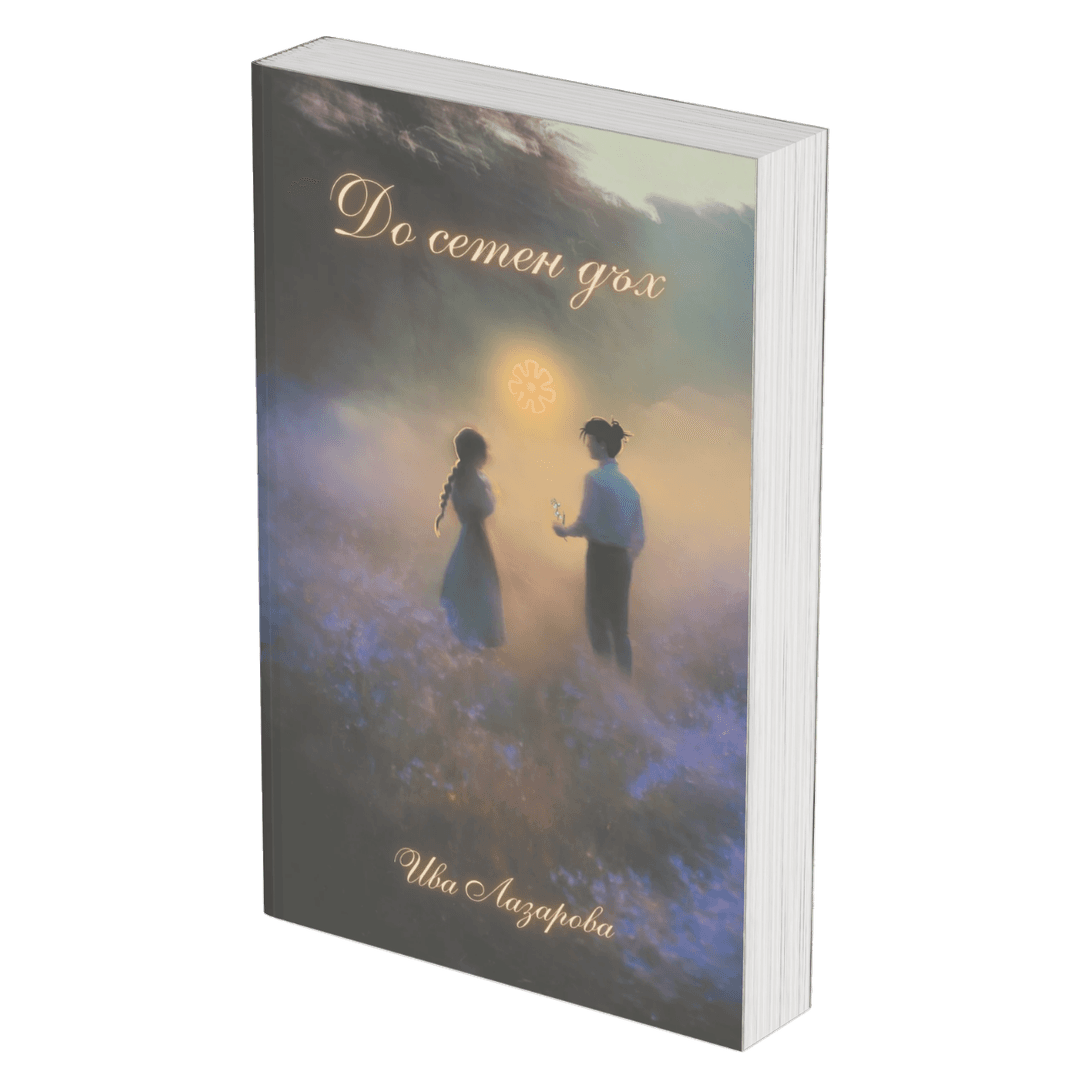
Корица на историческия роман „До сетен дъх“ от Ива Лазарова

The World

Before Everything Changed

In the age before the Christianization, when the old gods still whispered and the new ones still waited, life was a balance on a knife's edge.

Warriors and Boyars

Bulgaria is torn between those loyal to the old gods and those who see power in the new faith. Boyars plot conspiracies while warriors choose sides.

Faith in Son

Son - the solar wheel - is more than a symbol. It is life, fire, and memory. For priestesses like Kelara, it is the only true thing.

Historical Authenticity

The ninth century, a neglected period of Bulgarian history, told with historical precision and a delicate touch of the mythical.

"Some choose faith. Some choose love. Few have the courage for both."

Timeline

The 9th century in brief

“To the Last Breath” unfolds in the decades around one of the hardest decisions in Bulgarian history. Here is where the novel sits in time.

  1. 803-814

    Khan Krum

    Bulgaria establishes itself as a power in south-eastern Europe. The state is pagan, and the old faith is part of its military and clan order.

  2. 852

    Boris I takes the throne

    He inherits a state pressed between Byzantium to the south and the Frankish Empire to the west. Both are Christian.

  3. 864

    The Christianization

    Boris I accepts Christianity from Constantinople. The decision is as political as it is spiritual - but for millions of people it means abandoning everything they believed.

  4. 866

    The boyars' revolt

    Fifty-two boyars rise against the new faith. The revolt is crushed and its leaders executed along with their families. This is the heart of the novel.

  5. 866

    The Responses of Pope Nicholas I

    Boris sends questions to Rome, seeking an independent church. The hundred and six answers remain one of the most detailed sources on Bulgarian daily life in that century.

  6. 870

    A Bulgarian archbishopric

    A council in Constantinople grants the Bulgarian church its own hierarchy. The religious choice is final.

  7. 886

    The disciples arrive

    Clement, Naum and Angelarius reach Bulgaria after being driven out of Great Moravia. The Bulgarian literary tradition begins.

  8. 893

    The Council of Preslav

    Old Bulgarian becomes the language of church and state. The century ends with something nobody at its start could have foreseen.

The years follow the accepted chronology. Historians dispute some of them - a closing essay in the book covers the sources and what is documented versus what is imagined.

Characters

Mystical gods and the new faith

Kelara

Believer in Son

A young woman marked by loss, unsure of the future. She seeks meaning in the old gods and knows more than she says.

Bayan

The warrior leader

Firstborn son of a powerful clan, torn between duty to his family and his own desires. His goal is clear - Kelara is the only unknown.

Prologue

Prologue

"Mama, is father there with you?" I whimper from beneath her, digging my small fingers into the coarse fabric.

Damp air, thick with blood, batters my hair. A faint rumble of horse harnesses cuts through the ground beneath my feet. Mother, her hands trembling, pulls me by the arm. She doesn't look at me, but I know she's afraid. Her wide eyes, like glass beads, stare lifelessly, and her face, usually warm as Son's own image, now glows pale. Then, pulling her headscarf tighter to her neck, she says:

"It's battle, my daughter. Your father is fighting for us, for our kin. Go, find some royal herb... over there, by the river. You know it, don't you?"

"Mhm..."

A faint smile crosses her face, weighed down by thoughts far from mine. She lets go of my little hand and fixes her gaze on the impenetrable forest.

Slowly I crouch and stroke the ground. I press my ear to it, trying to hear the sound of battle.

Is father fighting there, and is it dangerous?

The finches are silent, and only the stream murmurs. The soil is dry, folding into deep creases around every blade of grass. I hear nothing and rise quickly, as if scalded. With unsteady steps I run toward the river. Its restless current washes the stones in the worn-out trough. Mother had bought it from the Chakarar clan in the town of Pliska. They gave it to us as alms, though father was firm about it. He taught me seriously once, when he told me the story: "Little soul, whatever someone gives you freely, return to them from your heart whatever is dearest to you."

With effort I drag the wooden trough toward myself, its rough surface scraping my fingers. It was carved long ago, in seasons past. That's what Bayan told me, the eldest son of the wealthy clan. He whispered in my ear that every herb placed in it gains irreplaceable energy and power.

Suddenly a splinter pierces my thumb, pulling me instantly from my thoughts.

I look at my hand closely, childlike. It still smells of the ointment with lady's herb we mixed the night before, under the full moon of Son. But now I need royal herb, growing by the fastest part of the river. Warmed and loved by the sun's rays. Ahaaa! There it is, at the edge of my sight.

Excited, I run to it barefoot. I feel the morning dew on my skin, and the cracks in the earth thirstily drink every escaping tear. I gaze at the little blades and the gentle dance of the wind with the droplets. Together, in symphony, they gather and part. A true whole in their essence, one that cannot be so easily divided.

A sharp sound cuts through the air above me, pressing me to the ground. I don't move, frozen, watching the dance stop. I hide within myself, retreating into my own heart. Darkness engulfs me and fills the place with smoke.

I breathe, I exhale.

I open my eyes abruptly, and the river has turned the color of wine. I sit paralyzed, and I make no sound.

Glossary

The words in the book

A few terms that recur in the novel. You need to know none of them beforehand - the book explains them as it goes.

Son
The solar wheel. In the novel Son is the supreme principle of the old faith - life, fire and memory at once. The name and the cult around it are the author's reconstruction, built on the solar symbolism documented in Bulgarian and Slavic paganism.
Boyars
The high aristocracy of medieval Bulgaria. They controlled lands and armies, and in the 9th century they were the most serious opposition to the ruler. It was they who rose against the Christianization.
Khan
The title of the Bulgarian ruler before Christianity. After the conversion Boris I replaced it with the Christian title of knyaz (prince).
Pliska
The first capital of the Bulgarian state, from its founding until 893. A stone city on the plain, with a palace, fortress walls and pagan sanctuaries.
Paganism
The blanket term for pre-Christian belief. Not one religion but a body of clan cults, rites and deities, differing between the Bulgars and the Slavs.
Kapishte
A pagan sanctuary - a place of rites and sacrifice, often under open sky. Foundations of such structures have been excavated at Pliska and Preslav.
Priestess
A servant of the cult who leads the rites and keeps the memory of the clan. In the novel, Kelara is a priestess of Son.
Bulgars
One of the groups from which the Bulgarian people formed, alongside the Slavs and the local Thracian communities. They brought their own military order, calendar and beliefs.

FAQ

Questions?

When will I receive the book?

The books are already off the press! As soon as you order, we prepare your copy - hand-signed, numbered and packed - then it ships with Econt. From order to delivery usually takes 2-3 business days.

Do you ship internationally?

Currently we ship within Bulgaria only. If you live abroad, email us at iva.lazarova.draws@gmail.com. We look for a solution for every scenario.

Can I cancel or change my order?

If there's an issue, email us within 24 hours of ordering at iva.lazarova.draws@gmail.com. Once the parcel has shipped, we cannot guarantee changes.

Why only 100 copies?

We chose a limited print run to guarantee quality: a personal handwritten signature, genuine contact with each reader, and zero compromises in the edition. If the copies from this limited run sell out, don't worry! We'll launch a second print run so the story can reach everyone who wants it, though without the collectible hand-written card.

Is payment secure?

You pay when you collect the parcel - cash or card at the Econt counter. Nothing is charged online and you never enter card details anywhere.

Reader reviews

What readers are saying

5.0

based on 3 reviews

Плаках накрая. Да, и аз.

Да си призная: авторката ми е годеница, така че не съм безпристрастен. Гледах как се пише тази книга вечер след вечер и пак не бях готов за края. Героите са толкова живи, че се ядосвах на хора, които не съществуват. Има едни второстепенни персонажи, уж второстепенни, а всъщност важни, на които ми идеше да кажа две приказки лично. Баян ми е любимият. Невероятен мъж, и няма да издавам защо. Историята е уникално преплетена с любовта. Чиста, истинска любов, вързана за природата и старата вяра, а не за това, което някой отгоре е наредил да се вярва. Има и много скрита символика, половината сигурно съм я изпуснал. На места ме хвана яд, но на историята ни, не на книгата. Колко много е изгорено и изтрито от онова, в което хората са вярвали преди покръстването, и колко силни и свързани са били. И най-интересното: хората в девети век са си същите като нас. Същият инат, същите интриги. Хилядо години по-късно, нищо ново. Четях и си го представях като филм. Ако някой режисьор чете това, сценарият е готов. Носете си кърпички.

Симеон Ковачев · October 2026

Плаках накрая. Да, и аз.

Симеон Ковачев · October 2026

Да си призная: авторката ми е годеница, така че не съм безпристрастен. Гледах как се пише тази книга вечер след вечер и пак не бях готов за края. Героите са толкова живи, че се ядосвах на хора, които не съществуват. Има едни второстепенни персонажи, уж второстепенни, а всъщност важни, на които ми идеше да кажа две приказки лично. Баян ми е любимият. Невероятен мъж, и няма да издавам защо. Историята е уникално преплетена с любовта. Чиста, истинска любов, вързана за природата и старата вяра, а не за това, което някой отгоре е наредил да се вярва. Има и много скрита символика, половината сигурно съм я изпуснал. На места ме хвана яд, но на историята ни, не на книгата. Колко много е изгорено и изтрито от онова, в което хората са вярвали преди покръстването, и колко силни и свързани са били. И най-интересното: хората в девети век са си същите като нас. Същият инат, същите интриги. Хилядо години по-късно, нищо ново. Четях и си го представях като филм. Ако някой режисьор чете това, сценарият е готов. Носете си кърпички.

„До сетен дъх“ ме грабна още от първата страница и не ме пусна до самия край. Прекрасен дебют, който горещо препоръчвам на всеки. „До сетен дъх“ не е просто поредната суха историческа книга, а разказ с душа. Историята на Келара и Баян ме развълнува истински. Огромно браво на Ива Лазарова, чакам следващите ѝ книги с нетърпение! 👏❤️

Габриела Антонова · September 2026

Габриела Антонова · September 2026

„До сетен дъх“ ме грабна още от първата страница и не ме пусна до самия край. Прекрасен дебют, който горещо препоръчвам на всеки. „До сетен дъх“ не е просто поредната суха историческа книга, а разказ с душа. Историята на Келара и Баян ме развълнува истински. Огромно браво на Ива Лазарова, чакам следващите ѝ книги с нетърпение! 👏❤️

Уникална книга

Образите са изключително реални, развити и те карат да съпреживяваш всичко с тях.

Иван Петров · August 2026

Уникална книга

Иван Петров · August 2026

Образите са изключително реални, развити и те карат да съпреживяваш всичко с тях.

Order your copy

The next copy is no. 69 of 100. 32 left.